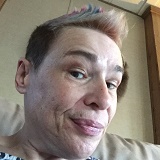
An interview question that I dread being asked is “Tell me about yourself.” (Todd Bermont, in his course 12 Steps to a Successful Job Search, states this question shows a lack of preparedness on behalf of the interviewer.[1] It says more about the company and less about interviewee. Nevertheless, I find it interesting how people answer that question. I realize it tells how a person views him/her/them self.) At most job interviews, I tend to talk about my paid and unpaid work and any personal attributes that assist me to acquire that job. I laugh when I thinjk back to a time when the attributes that I gave -loyal, dependable, and hard working- were comparable to that of a Golden Retriever! In a social situation, I might talk about my disability or growing on a farm after introducing myself. These descriptors are the first details that come to my mind and are indicators of how I see myself. For this blog post, instead of using my past experiences or personal attributes as descriptors of myself, I illustrate who I am as a person by telling you about my reaction to a recent event that defined a lot of people —the pandemic of COVID-19.
Close to the end of December 2019, news of the COVID-19 virus trickled into my life from my TV, computer, and phone. In fact, I remember reading the news on Facebook. Some of my friends suggested that they may have had this illness in November or December. We didn’t think of it as “all that bad” because some of us experienced this virus. I also consoled myself with the fact the SARS virus, although very awful, didn’t venture past the East of Canada or, at least, I don’t even remember if there were any cases of the SARS virus in Alberta. My mantra was “they’ll stop it before it comes to our country or province.” However, almost overnight, this international pandemic came to both Canada’s and then Alberta’s shores.
The Covid19 virus arrived on doors as quickly as an Alberta cold snap and, with rapid succession, began to close various businesses, organizations, and government agencies in Canada. By mid-March, Canada was in lockdown and my whole world changed. I went from “taking a break” to feeling imprisoned by an invisible enemy. As a result, I scrambled to find ways to help cope and be distracted from this crisis. I looked to some new coping strategies that I learned from working at Canadian Mental Health Association.
My first strategy was to exercise. I had an elliptical, and I wasn’t afraid to use it! In the past, I used exercise to weight loss, to complete goals and to feel accomplished, and to reduce stress. As previously mentioned, I took up “virtual walking” to ensure that I could have a safe place to exercise my muscles while regaining strength, flexibility, and control over them. Boredom was the biggest catalyst for this type of walking. I focused on setting goals and achieving them and it helped me have a sense of agency over my circumstances, gave me a sense of achievement, and, distracted from the COVID-19 crisis. While exercising on my elliptical, I thought of other ways to cope with lockdown.
In March 2020, I added two more goals – learn a language and start to mediate. I paid for a language application and a Christian mediation application to distract me as well as bring productivity in my life. In the past, I noticed I was forgetting words as well as where I placed items in the house. At the time, this type of forgetting didn’t worry, but lockdown seemed to magnify my forgetfulness, and I began to search for help with my memory. (My mom has Alzheimer’s disease, and so for me, forgetfulness was a big concern.) I had heard that learning a language helps create more resiliency against neurodegeneration in brain[2], and meditation may reduce stress, insomnia, and heart disease risk, factors associated with Alzheimer’s disease[3]. Every day I practiced French and Spanish to create resiliency in my brain, because, of course, learning one language wasn’t enough—type A personality, here! Every night I listened to a Christian meditation on the Bible verses or cope with different struggles (depression, anxiety, and doubt) I faced during lockdown. These applications helped me to practice self-care and enabled me to feel hopeful.
In June 2020, I knew that I needed more than Bible readings, meditation, and exercise. I needed an activity that would not only preoccupy my time but helped me feel like I was adding to the world, or at least, to my world. I searched on the internet and found Ed2go courses through the public library. I decided, that if I could not go anywhere or do anything outside my home, I would begin writing like I dreamed of since I was a little girl. However, before I would start writing, I wanted to improve my writing skills. My first course was essentials to writing – which I totally loved! I learned about spelling, word choice, and sentence structure – to name a few of the skills in this course. (My current writing skills are by no means a reflection on the teaching skills of the instructor. My lapse between proper writing skills and my own writing skills are from lack of follow up with this course and practice. I own it!) I have participated in some grammar courses, a job search class, and an assertiveness class. Each class helped to feel productive as well as to step out and begin to write my thoughts on my laptop. A blogging class for course gave me the skills and courage to start this blog. I felt that, despite or because of the pandemic, I beginning to gain confidence, skills, and to live my best life.
As the year of 2020 ends, I looked back on many of my goals and felt proud of my achievements. Every year, since 2016, I worked on the “You vs. the Year” challenge in my Underarmor app. (The challenge is completing one thousand kilometers plus the last two digits of the year. For example, for 2019, the goal was 1019 km.) At the end of the year, I not only finally this goal of 1020 km, but surpassed it by 138 km, to make a grand total of 1158 km! Yay, for me! I also completed my goal of reading one hundred books in a year. As far as a virtually walking, I made great strides toward finishing that goal. I managed to walk from Jasper National Park located in Alberta to Clearwater Bay, Ontario—a grand total of 1,862.2 km for 2020. If I were to add this total to the of 2019, where I virtually walked the entire province of B. C. (824 km), it would be a grand total of 2,686 km out of 7,560. 6 km of Canada. I was elated by these accomplishments. Lastly, I participated in five classes and completed four of those five classes. I felt like I achieved a many of my goals. I took a year that began in fear and shock and turned it into a year of courage, confidence, and productivity. I dug down deep and found that I am a person who takes on initiative and succeed! I saw myself in a whole new way!
Everyone deals with challenges in different ways. No one way is better or worse than another way. The challenge becomes taking that risk to try a different approach how you deal with life’s ongoing difficulties. I decided to experiment with how I would confront this new threat to my world. I was happily surprised that what I taught to other people I was putting into practice. Now, I see myself in whole new light.
[1] Bermont, Todd. “Twelve Steps to Successful Job Search.” Online Courses for Shortgrass Library, Cengage Learning, https://education.gale.com/l-shortgrass/online-courses/12-steps-to-successful-job-search/?tab=detail.
[2] “Klein, Raymond M., et al. “Does Multilingualism Affect the Incidence of Alzheimer’s Disease? A Worldwide Analysis by Country.” SSM – Population Health, Elsevier, 30 June 2016, https://www.sciencedirect.com/science/article/pii/S2352827316300313
[3] “Meditation – Its Effect on Cognition and General Well-Being.” Alzheimer’s Drug Discovery Foundation, https://www.alzdiscovery.org/cognitive-vitality/blog/meditation-its-effect-on-cognition-and-general-well-being.